

Most of us know the first two words in the longevity conversation. Lifespan is how long you live. Healthspan is how long you live without serious illness.
There is now a third one, and it asks a sharper question: how long do you stay close to your best?
That is peakspan, and it has gone from a research paper to a talking point in a matter of months. This article covers what it means and what a DNA test can honestly tell you about it.
Peakspan is the number of years you keep at least 90% of your own peak performance in a particular physical or mental function, such as aerobic fitness or fast thinking. It was proposed in 2026 by Alex Zhavoronkov, Kejun Ying and Dominika Wilczok in Aging and Disease (DOI 10.14336/AD.2026.0080). It is a framework, not a clinical test.
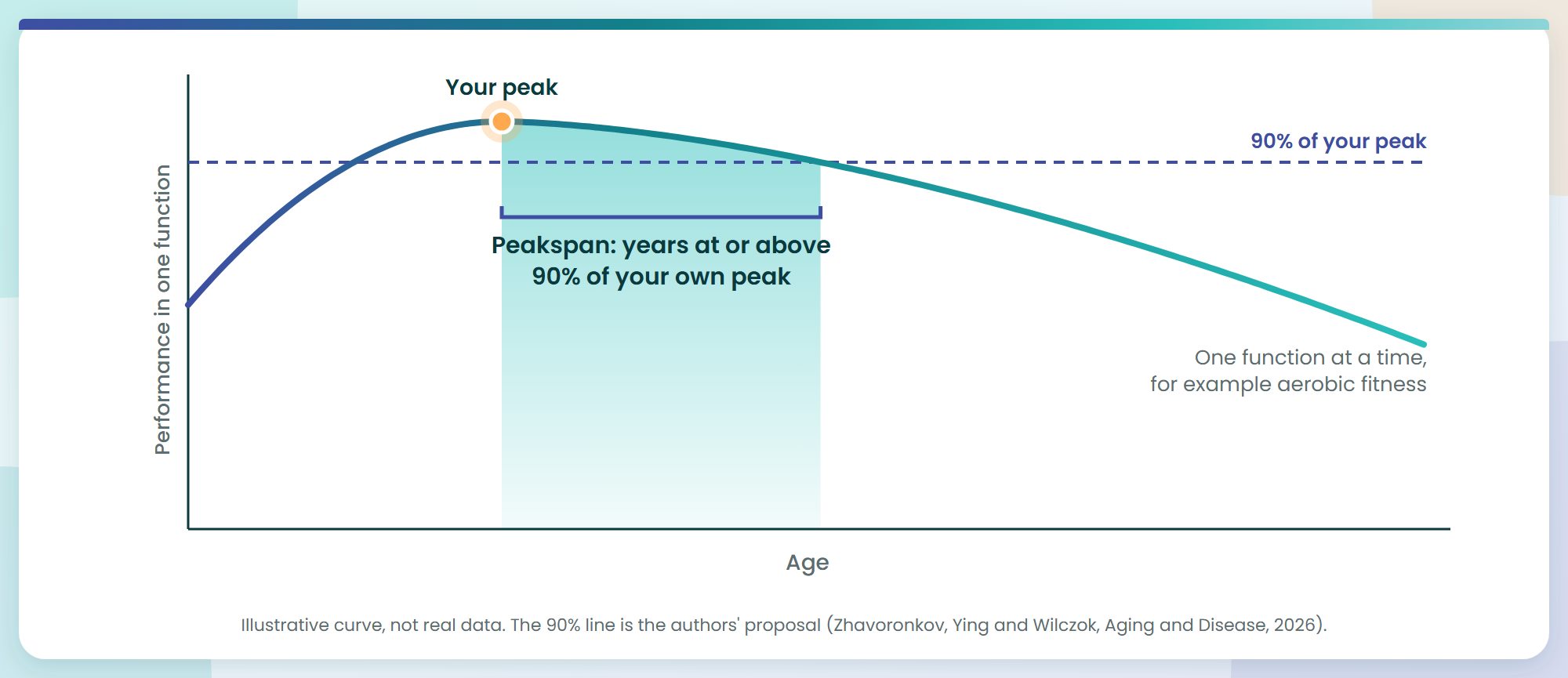
Two ideas sit behind it.
Most body systems peak early. The authors argue that many functions, including cardiovascular fitness, muscle strength and certain kinds of thinking, reach their best in your 20s or 30s and then ease off gradually. That happens in people who are perfectly healthy by any medical measure.
It is measured one function at a time. Your fitness peakspan and your memory peakspan are separate things. There is no single peakspan score for the whole of you.
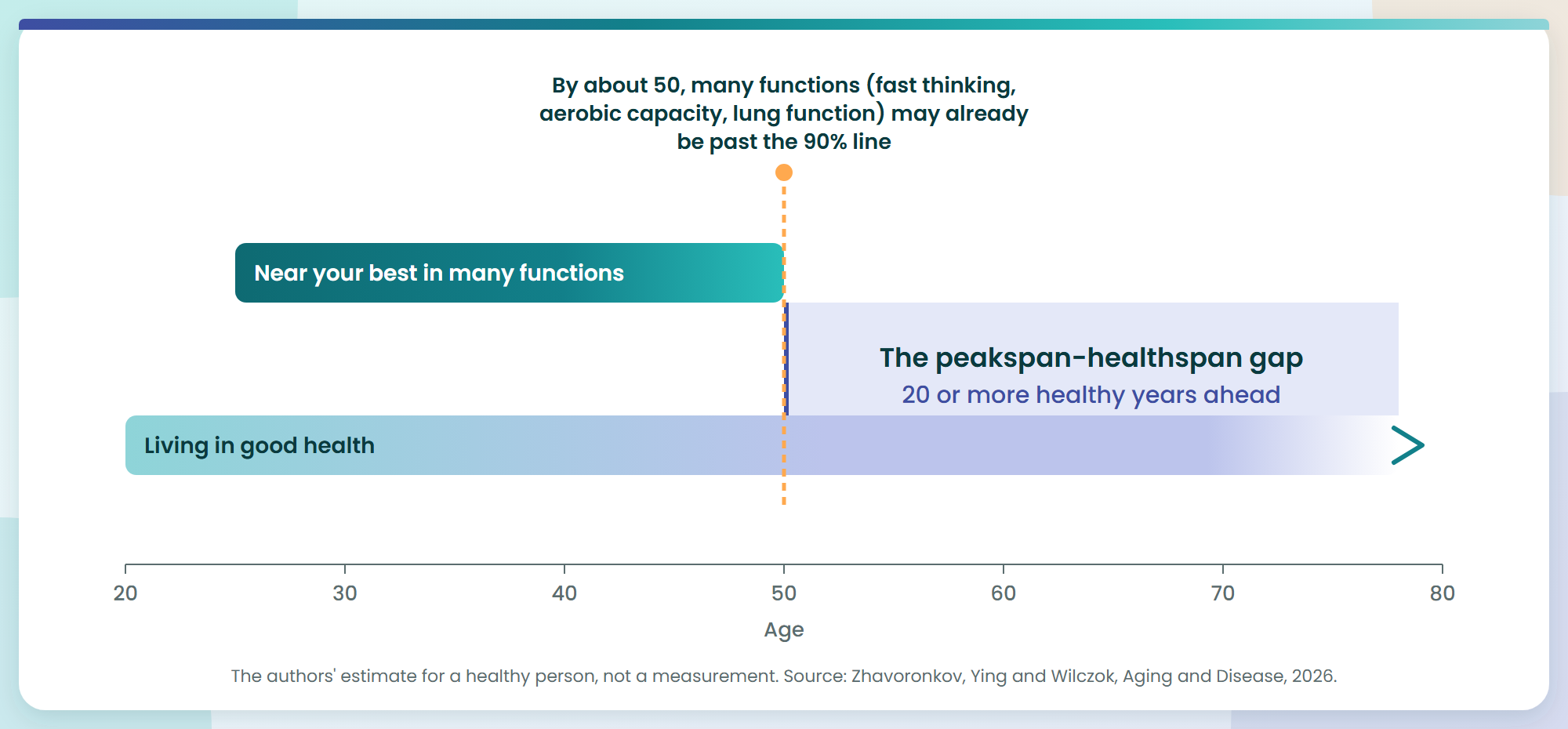
The authors call the space between the two the peakspan-healthspan gap. Their estimate is that by 50, a healthy person has likely moved past the 90% line for most functions, including fast thinking, aerobic capacity and lung function, while still having 20 or more healthy years ahead. It shows up in ordinary ways long before any diagnosis: slower reactions, less endurance, catching infections more easily.
That gap between “not ill” and “still at your best” is why the idea has caught on. Healthspan can look fine while strength, stamina, sleep or sharpness change gradually.
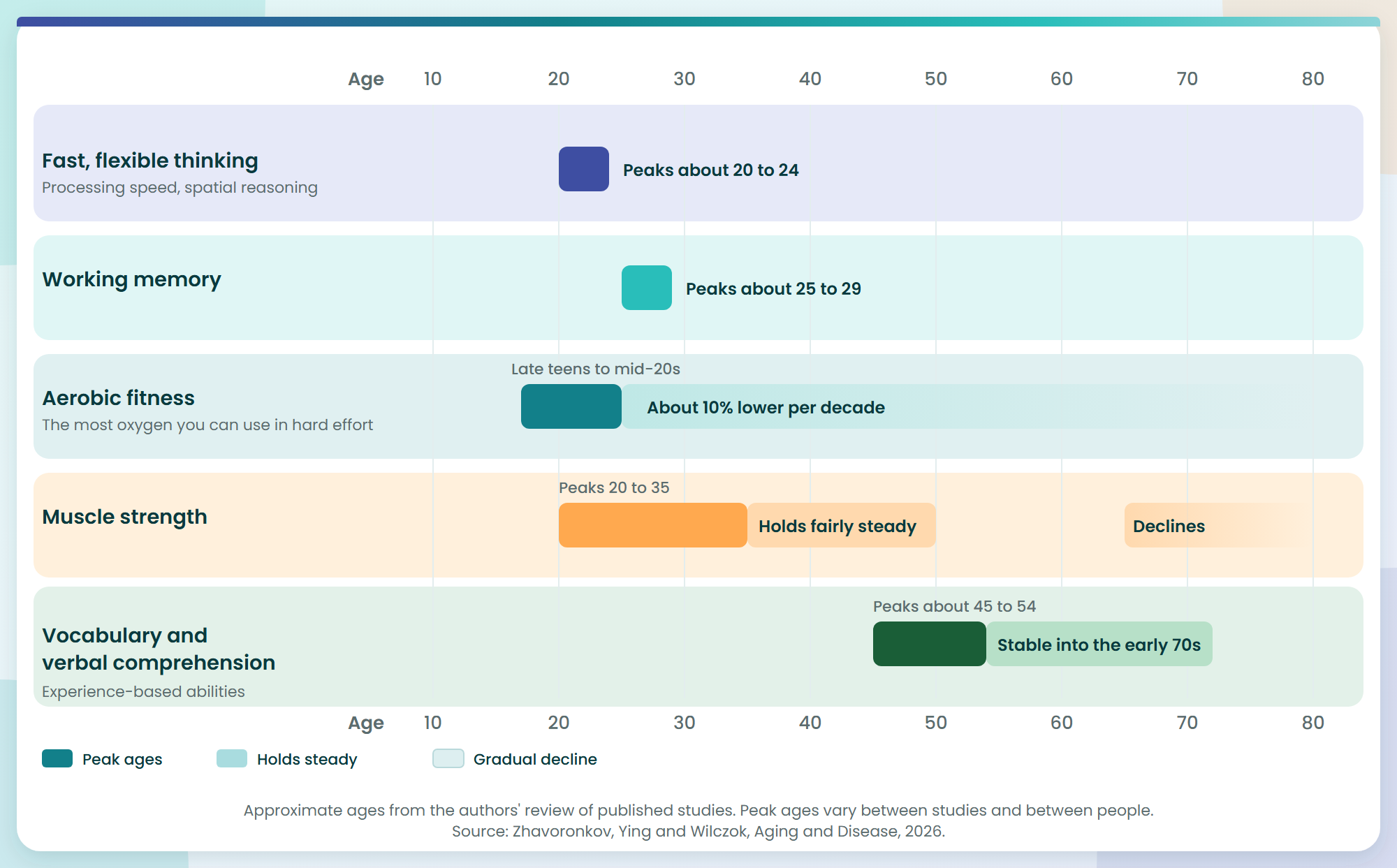
According to the authors’ review of published studies:
So not everything peaks early. What you know and how well you use it keeps growing long after your sprint speed has gone.
Peakspan is a proposed framework, not an established clinical test. The 90% line was chosen by the authors, and the paper pulls together existing research rather than reporting a new study that follows people over decades. The lead author is affiliated with a longevity biotech company, which the paper declares. It is a useful way to think about ageing. It is not yet a number your doctor will measure.
Claims online get loose at this point, so to be direct:
Genetics accounts for roughly 30% of health outcomes. The other 70% is what you do with it. A DNA test helps with that 30%, and it helps most by making the 70% more targeted.
The paper itself notes that genetics, sex and lifestyle all shape both how high your peak is and how quickly you move away from it. The reports in the MyDNA DNA Test, which comes with a personal consultation, cover areas that relate to several of these functions, such as fitness, sleep and nutrition.

Your genes influence how you respond to different kinds of exercise. The fitness reports include Muscular growth, Lower body strength, Explosive strength, Muscular endurance, Cardiovascular endurance, Heart rate recovery and Flexibility. There are also reports on tendon and joint injury, including Rotator cuff injury, ACL injury, Achilles tendon injury and Ankle injury.
Why it matters for peakspan: strength and cardiovascular fitness are two of the functions the peakspan authors discuss. Knowing whether your body leans towards endurance or power, and where you may be more prone to strain, helps you build a programme that keeps you training consistently instead of repeatedly starting over after an injury.

Sleep is where the body repairs itself, and people differ a great deal in how they sleep. The sleep reports cover Deep sleep, Sleep latency, Insomnia, Excessive sleepiness, Daytime nap and Circadian rhythm.
If your results show a tendency towards lighter sleep or a later body clock, a good plan works with that, with timing, light, caffeine and wind-down habits set around how you are wired.

This is the area many people find most useful, because food is something you decide on three times a day. The reports include genetic tendencies around Vitamin D level, Vitamin B12 level, Folate level, Magnesium level, Iron level, DHA level, EPA level and Caffeine metabolism. Weight and diet reports cover Resting metabolic rate, High fat diet response, High protein diet response and Calorie restriction diet response.
These are tendencies, not blood tests. They tell you where your body may need more attention, so your consultant can suggest where to focus, and where a blood test may be worth asking about.
Triglyceride level, LDL cholesterol level, HDL cholesterol level and Insulin resistance sit alongside reports on blood pressure and circulation. Knowing your predisposition early gives you time to act on diet, movement, nutritional support and regular check-ups, well before anything becomes a concern.
The reports include Aging and memory, Exercise and memory improvement, Long-term memory, Aging lung function and Telomere length and aging. For skin, there are Skin elasticity, Photoaging and Glycation and aging.
None of these predicts what will happen to you. They show where your genes lean, and they give you a reason to put the habits that support brain, lung and skin health at the top of your list.

A report on its own is a long document. What matters is turning it into a handful of changes you will actually keep.
With MyDNA, that is built in:
Because the plan comes from your own report, it replaces generic advice with priorities that fit you.
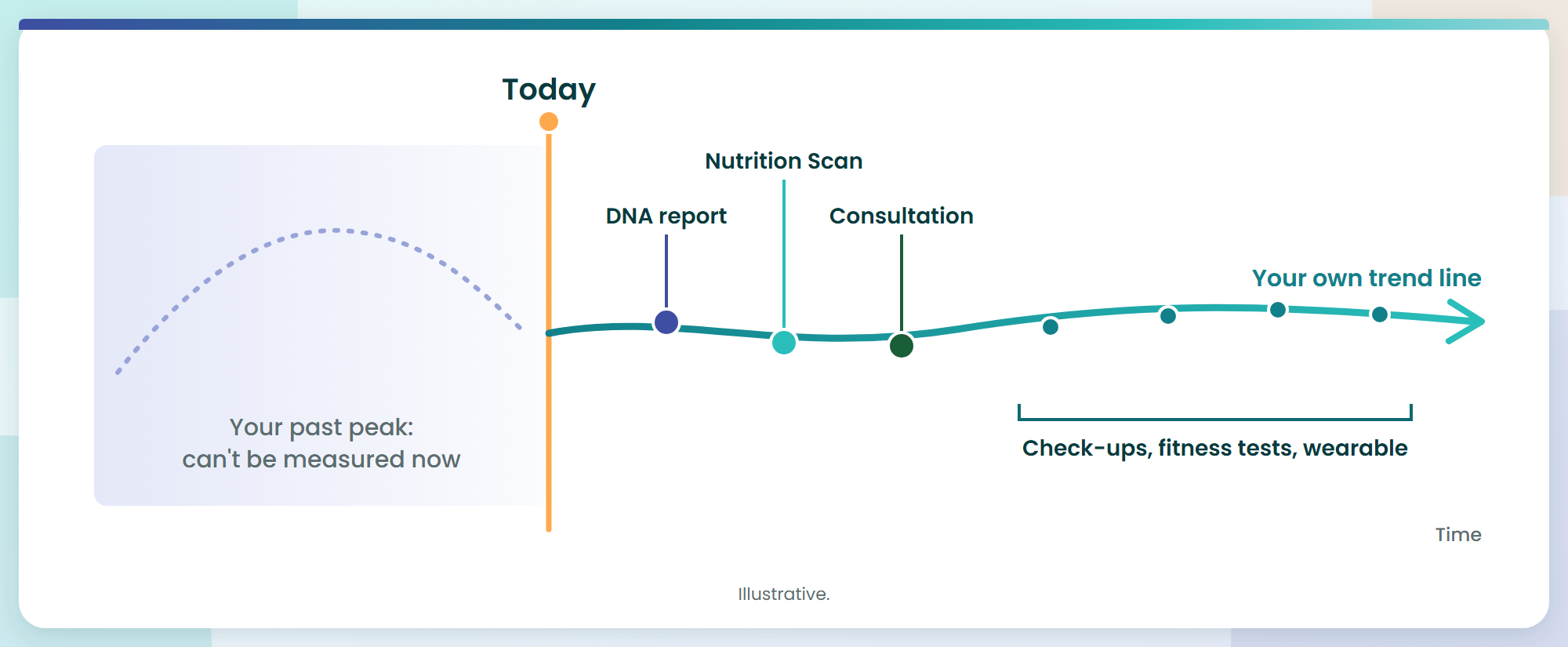
Peakspan measures how far you are from your own best. Almost nobody has numbers from their 20s to compare against, and the authors acknowledge that measurements vary between studies and are hard to line up against a single peak.
So there is no point trying to reconstruct the past. Start from today:
Starting a baseline now gives you something to compare against next year.
Yes. Your DNA does not change, so there is no “too late” for the information itself. If you are in your 40s, 50s or beyond, the useful question is which areas deserve your effort from here.
Nobody can promise that a particular habit will restore or extend a function. The research on peakspan is early, and the authors say as much. What a personalised plan can do is point your effort in the right direction.
Explore the MyDNA DNA Test, or talk to a consultant. Helix, our assistant, takes a few details first and then connects you with the team.